Friday, 26 April 2013

Is there life in the old dog yet?

I've always thought that the PE ratio is an odd concept. Why divide price by earnings when turning the calculation on its head gives you a percentage yield which you can readily compare with the dividend yield or a rate of return on bonds or bank deposits or indeed any other yield figure you can think of.

After all if you are the owner of a stock your share of the earnings belongs to you whether it is distributed in the form of a dividend, or if it is retained by the company to build the business. Your business. So why not think of it as a return on your investment.

Lets have a look at some rates of return as published by the Wall Street Journal. I'll concentrate on the Dow Jones Industrial Average. The others are there to be examined if the mood takes you. I'll focus on this year though the table also shows last year for comparison. And the forecast earnings are presented as a PE based on the current price to help you look into the future.


Yields on stocks vs. yields on bonds


The dividend yield on the Dow Industrial is 2.44%, slightly down from last year. If we invert the PE ratio (lets call it the Earnings Yield) it was 6.2%. (Just to be clear we are saying that if you held equal positions in all of the 30 DJI companies your investment would yield earnings of 6.2%. 2.4% would be distributed as dividends and 3.8% would be retained by the companies to grow their businesses.)

How does this compare to the return on bonds?

The yield on one year bonds is below 0.25% It does not compare well, does it? Even the yield on 30 year bonds at 2.9% is not very enticing. 

2.9% might look better than 2.4% but you have to bear in mind that the cash value of the bond will be the same in 30 years time and that value will have been eroded by inflation. Businesses in the DJI will have grown and at the very least will have kept up with inflation.

So if you look at that earnings yield and compare it with the return on bonds it is evident that the stock market could comfortably increase beyond its present value. Looked at this way the previous all time high does not look like such a great hurdle to jump. AS LONG AS INTEREST RATES AND BOND YIELDS STAY LOW. Government policy all over the world indicates that, for the foreseeable future they will. But be very afraid of the moment when those rates begin to rise. 

In the UK


Over here in the UK the picture is much the same. The FTSE has an average PE ratio of 14.1 which translates to an earnings yield of 7.1%. Dividend yield is 3.8%. This compares with 0.26% for a 2 year government bond and 3% for a 30 year bond. Again there is pressure which could drive the stock market higher.

Even central bankers have caught the bug


After preparing this little analysis I came across an item on Bloomberg which just goes to underline the point I am making. Here's a little extract:

Central banks, guardians of the world’s $11 trillion in foreign-exchange reserves, are buying stocks in record amounts as falling bond yields push even risk- averse investors toward equities.
In a survey of 60 central bankers this month by Central Banking Publications and Royal Bank of Scotland Group Plc, 23 percent said they own shares or plan to buy them. The Bank of Japan, holder of the second-biggest reserves, said April 4 it will more than double investments in equity exchange-traded funds to 3.5 trillion yen ($35.2 billion) by 2014. The Bank of Israel bought stocks for the first time last year while the Swiss National Bank and the Czech National Bank have boosted their holdings to at least 10 percent of reserves.
“In the last year or so, I have spoken with 103 central banks on diversification,” Gary Smith, London-based global head of official institutions at BNP Paribas Investment Partners, which oversees about $649 billion, said in a phone interview. “If reserves are growing, so are diversification pressures. Equities are not for every bank tomorrow, but more are continuing down this path.”
Managers of banks’ assets are looking for alternatives to holding government bonds after efforts to stimulate growth from the Federal Reserve, the Bank of Japan and the Bank of England helped send yields near to record lows. Central banks’ foreign- exchange holdings have increased by about $8.5 trillion globally in the past decade, exceeding levels needed for day-to-day currency administration. 

The market today


Today the markets seem to be taking a breather, so far.


Wednesday, 24 April 2013

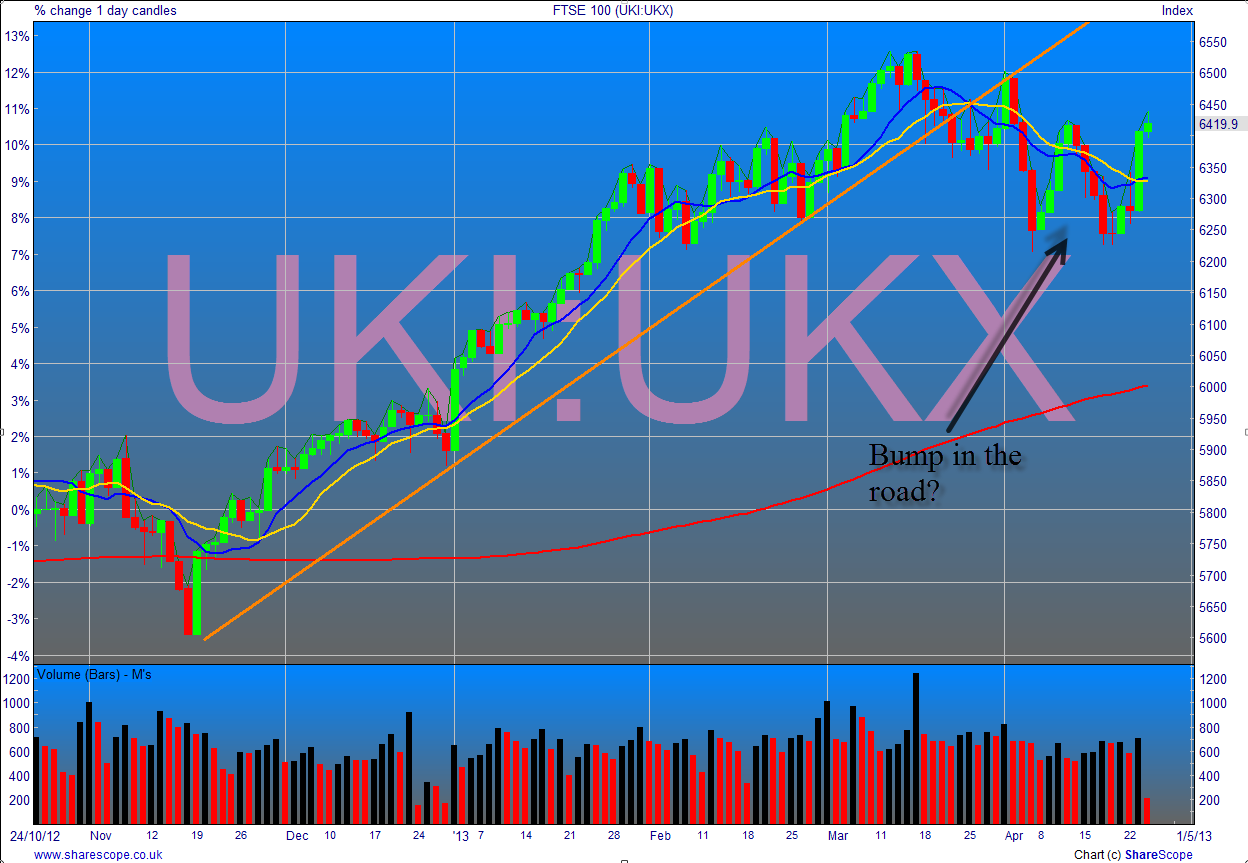
Bump in the road


Looking at the charts I begin to get the feeling this is not a change in direction but a bump in the road. The DOW and the S&P have both arrived at their previous all-time high and, not unexpectedly, they have taken a pause for breath. All those doubters, including me, have thought to themselves “This is it boys, end of the line,” and have dumped their holdings. But the bulls have been sitting there keen to fill their boots with temporarily cheaper shares. Not so much arriving at the buffers, more a case of negotiating a series of sets of points. (I’m enjoying mixing my metaphors.)

If this new view is right, then the bull market has further to run. If I was wrong before and am right now what was it about my analysis that led me astray?

I've said it before and I’ll say it again. All that cash the governments in the major western economies are dishing out to the banks through QE has to cause inflation somewhere. The market which is being inflated is the stock market.

But there is something else which I have ignored: low interest rates. If interest on bonds and deposits is close to zero and the dividend return on shares is much higher (around 3% for the DOW for example) then the choice for investors with cash becomes a no brainer. As long as you are buying solid companies with good market franchises you can do much better investing in the stock market, even at current levels, than keeping money on deposit.

For banks it makes more sense to lend to stock market investors than to small businesses who, in tough economic times, are bound to be vulnerable.

I plan to research this idea a bit more thoroughly and will post shortly.

In the mean time we need to keep a sharp eye on the pattern the market is making to see if we have run into an enormous sleeping policeman or if we have reached the end of the road.

Here, for a change is the chart of the FTSE which shows a very interesting, lumpy picture.


What neuroscience is is telling us about consciousness

The ravenous brain inside your head is bombarded, every waking moment, with a flood of stimuli both internal and external. In order to cope with all this information, the brain ravenously searches for patterns to condense information into chunks that can be more efficiently absorbed and digested inside the limited space available for conscious attention.

Daniel Borbegins his book about the latest discoveries in the new science of consciousness with two anecdotes. He visits his father who has been struck down by a stroke. If he sits on his father’s right side, the man he used to know is aware of his presence and is able to converse, sort of. Sitting on his left, his father is unaware of his son and behaves as if he was not there. The man looks like his father but displays none of the personality or cognitive ability that made him recognisable as the man he used to be. The stroke has damaged his brain, breaking the neurological links that generated his ability to think and respond in the manner which characterised his personality. Injure the brain and the mind is crushed.

The second anecdote describes Bor as the subject of an experiment. An MRI scan reveals that imagining a physical activity, such as playing tennis, lights up one part of the brain, while visualising places, such as home, activates a different section. In the experiment, Bor is asked to imagine playing tennis when he wants to give the answer no to questions and to visualise wandering around his house when he wants to answer yes. The experimenter observes Bor’s brain activity on the MRI monitor; he obtains Bor’s responses by looking into
his brain. He has no other access for Bor does not speak. The experiment shows that observing the brain provides direct access to the mind.

These two anecdotes point to the conclusion that the brain, a physical, mechanical and electrical entity, is identical with the mind.

The main thrust of the book reveals what neuroscience is discovering about consciousness. Bor began his academic studies in philosophy. He was well-versed in the philosophical discussion about the separation between mind and body (or soul and body as philosophers with a more theological bent might prefer). But suddenly, with the powerful new tool of the MRI scanner, neuroscientists were making discoveries which rendered those philosophical discussions void. Bor switched his studies from philosophy to neuroscience.
In this book, he sets out to describe what is now understood about human consciousness. The brain is a complex mechanism that works by sending electrical messages from one neuron to the next in vast cascades. The overwhelming majority of these messages are passed subconsciously. The brain can be seen to be active without its owner having any awareness of what is happening. It controls the day-to-day bodily functions of breathing, moving etc. etc. and none of this normally forms any part of conscious awareness. This is also true of skills that have been acquired, such as driving a car or striking the ball with a golf club. All of this happens outside a person’s consciousness.

The brain is bombarded all its waking time by an array of sensory input from eyes, ears, nose, body sensations, and so on. However, the brain is constrained because it cannot hold more than about four items of information in its awareness at any one time. It therefore has to select which items to bring to the fore. The four items change constantly, and make up the ever changing stream of pictures that is consciousness. The brain is exquisitely attuned to juggling and shuffling the competing items of information and choosing which ones to present to the attention. This process of choosing, like most of the brain’s activity, is unconscious.
A second strategy that the brain employs to cope with unwieldy volumes of information is by “chunking.” It collects information which lies in the longer-term memory and groups it to present composite pictures that can be drawn to the attention. The brain shows exceptional skill in finding patterns and clues that allow it to group information to generate a coherent whole which can fill one of those four precious spots in the brain’s conscious attention. In this way, it can toss and turn information and find new and ever more complex patterns. It is the discovery of these patterns that has led to the rise of the human species, with the ability to garner and manipulate the resources of the planet and create the world as we know it.

An intriguing section in the book addresses the question of whether we can accurately discern consciousness in other animals. Another looks at research which uses MRI technology to identify consciousness in comatose patients and tries to forecast which ones are likely to recover at least a part of their normal consciousness.

The sheer complexity of the brain’s activities leaves it vulnerable to damage. Even in its physically undamaged state, it is prone to malfunction. The glitches are what we know as mental illness. Several conditions can be explained as breakdowns in the consciousness process. Autism, Bor argues, is caused by the brain’s poor control of an excessive amount of information presented to the conscious attention. This explains why many people at the more functional end of the autistic spectrum may have exceptional skills, despite being handicapped by the need to limit the sheer quantity of information that assails them. Like more seriously affected individuals, they withdraw from normal social contact and attempt to create a world where they can control the stimuli which assail them. At the same time they have access to greater numbers of stimuli which they can process into patterns more effectively than the rest of us.

At the other extreme, schizophrenics seem to suffer from a lowered awareness and find it difficult to distinguish between information that originates inside their brains and that which comes from sensory inputs. Their conscious attention is made aware of information, for example voices which originate inside their heads, and these inputs are construed as external. Acting on this belief results in the often bizarre behaviour that characterises the disease.

Research has shown that many brain malfunctions are associated with poor sleep patterns. In addition to correcting sleeping disorders, research has shown that meditation can be effective in improving the functioning of consciousness.

This is a fascinating book which brings the reader up-to-date with the latest research in this rapidly developing field of science. Bor’s use of anecdotes, and his injections of personal experience, illuminate the hard facts that he presents. He is a philosopher and a human being first, and this makes his review of the bald scientific evidence all the more appealing.

More Kindling


A loyal reader has pointed out that I am quite wrong about the Kindle. On the original machine there is a “Back” button which does exactly what I described as missing in my last post. You follow a link to the diagram or note and then press “back” and it’s as though you’ve never been away. I’ve tried it out and it works. Humble apologies, Kindle folk.

I’ve looked for an equivalent function on the Kindle application on my iPad and my Android phone. Here it works slightly differently. You press the link and are taken to your diagram, and then you press the diagram title to be taken back. I’ve discovered that this system is poorly implemented, with links often missing.
I have two remaining bugbears:

·         complex diagrams are totally mangled. 

·         links to notes in the Ravenous Brain do not exist, so going to the back to read about the research which proved the points made in the text means that you are back to square one. You have to reset the farthest point read by going onto the Kindle management site.


Monday, 22 April 2013

School of hard knocks


I don't know what it is about the spring but it seems to be the time when the stock market conspires to teach me that I can't always have it my own way. This year I have lost on gold - all sold now, I've lost on shares because I got my timing was wrong, my GVC holding pulled back just after the turn of the year (5th April) and now I am losing on the short positions I took out last week. It could be worse but staring at the size of my accumulated losses makes me sad.

Can I learn from this? I suppose. Avoid buying new shares unless the market looks really strong. Be much more careful about going short.

There may be help at hand. I have mention Vector Vest many times. It is the system I now use for picking shares. Fine when I get my timing right, lousy when I get it wrong. Luckily for me I make more when I'm on a roll than I lose on the downside. Still, as school reports are wont to say: " Could do better."

Vector Vest has a very sophisticated system for measuring timing.

  • It starts off by measuring the way the market has moved since yesterday and since 5 days ago. It awards a red, yellow or green light (unfavourable, neutral, favourable)
  • It uses a propietary indicator called the Relative Timing Index which measures the momentum in the market. This anticipates changes in direction. Again a red, yellow or green light
  • Each share in the market is rated a buy or sell based on its fundamental qualities and its individual price movement and momentum. The ratio of buys to sells is measured and the shift in the ratio is used as an indicator of the health of the market. Another red, yellow or green
  • The three indicators are amalgamated to create the market timing index providing a further measure of what is happening.
  • Short and medium term trends are assessed as up or down, using these measures
  • Looking at the longer term, two weekly movements are assessed to provide a measure of how the market is pointed providing a confirmed up or down

These measures provide guidance as to whether to be in the market or not. A recent refinement has been the addition of a moving average indicator. The 15 day and 10 day moving averages of the market are measured and when the 10 day is below the 15 day it is seen as negative for purchases even when the lights are green but when the 10 day crosses above the 15 day, it is a good time to act on buy signals.

With all of this complexity I have been daunted and have failed to use the market timing feature properly. But I have got my timing wrong too often and feel an urgent need to get my head round these signals. Never let it be said that I am unwilling to learn from my mistakes.

My latest error was to short the market when Vector Vest was sending out neutral signals. These turning points always spell danger. I should have learnt by now to stay away.

As I write the market has turned from the bullish signals that the futures market was showing. I shall hold on to my shorts until the situations becomes clearer.


Kindling


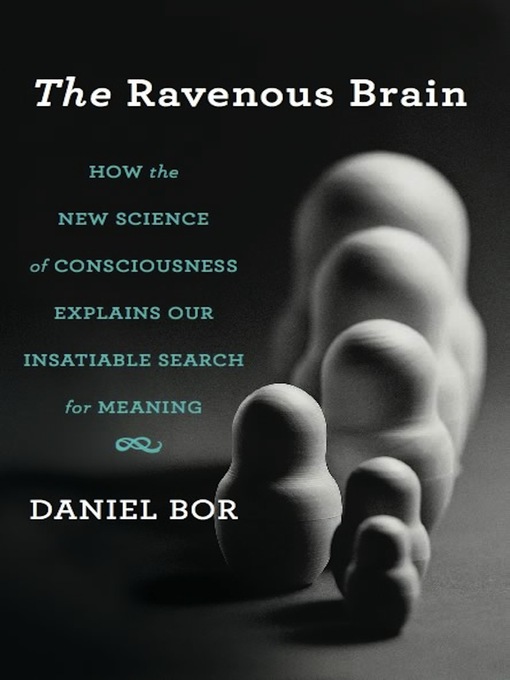
I have just finished reading a fascinating book: The Ravenous Brain by Daniel Bor. Bor began his studies in philosophy but moved to neuroscience, which is on the cusp of proving that there is no distinction between mind and body. I plan to review the book shortly. In the mean time you can find a short extract here.

I read the book on Kindle and found it a deeply frustrating experience. 

Kindle is my preferred way to read books. I am slightly dyslexic and I like to blow up the size of the print. which increases my reading speed by some 50%. Then there are all the other advantages. Because the book is on my mobile phone, it is always with me, I can read on a variety of devices, I can carry around a veritable library, I can buy new books almost instantly, wherever I am, and download them rapidly.

All of this is fantastic. BUT. A book like the Ravenous Brain has a lot of diagrams and pages of notes and references. Reading it on the Kindle and accessing all the resources is a nightmare. You can't skip to a diagram at the back of the book because the place you were reading is then lost forever, with the diagram becoming the "farthest place read". You can't look at the references for the same reason. Deeply frustrating.

Don't the people who design e-readers realize that they are working with computers, which are past masters at hopping happily from place to place? Gone are the days of reading in a straight line. 
At the very least, they could provide a "go back function." If you skip forward to look at a reference, there should be an automatic method to get back to where you were.

More is also needed but this is an indispensable function. Why has no-one thought to implement it? Better facilities for viewing diagrams would also help.

If e-readers want to move into the world of non-fiction books and serve their readers properly, they need to up their game.

Friday, 19 April 2013

Going down?

It really is too early to call a down on the market. True it has broken support. But there has been no exuberant rush as the last few doubters run to grab at the coat-tails of a dramatic bull run. There are few of the characteristic signs of a change in direction other than that the market has lost momentum.

A couple of days ago I sold most of my shares. I dumped the rump of my gold holdings as that market collapsed. Now I am wondering whether to play the market on the downside.

I have tentatively taken a position in and ETF code VXX. The next two charts show what it does. The first shows the S&P 500, the second the VXX. To make it clearer I have inverted the chart of the S&P 500 (so that when it is rising the chart points down and vise versa.)


If I'm right and the market does begin to crumble I should make a bit of money on the way down. Only time will tell.

Wednesday, 17 April 2013

He who fights and runs away

This is a quick note to say I've switched sides and I'm throwing in the towel. I think it's that gold shock that has unnerved me. No-one has a coherent explanation as to what happened or why.

It is ages since I gave up my subscription to Money Week and its sister publication the Fleet Street Letter - far too right wing for my taste and they both thrive on spreading gloom, doom and fear. Money Morning, Money Week's daily update opened with these words:

"They say that bull markets end with a bang, not with a whimper. 
We got our bang. The problem is, it was in the wrong direction. In just two days, the gold price fell by more than $200, from $1,560 an ounce to an intra-day low of somewhere near $1,330."

I fail to understand. The gold market has been in decline for months now and then it took a dive off a cliff. That is a bang but what direction was it supposed to be going in?

The article continues:

"It's estimated that some 400 tonnes of gold - almost 13 million ounces - were sold on Friday alone. That's about $20bn worth.
To put that in some kind of perspective, that is more than the entire holdings of the Bank of England, which are just shy of 10 million ounces. (Even after the debacle of the sales under Gordon Brown, we are the world's 18th largest holder). It's more than the holdings of Spain, Austria, Saudi Arabia, Portugal or Turkey. 
Of course, most of the gold sold on Friday was in derivative or paper form, and the same ounces may have been bought and sold many times over throughout the day, but the numbers are still extraordinary."
Well that is indeed amazing. But the article continues with no coherent explanation. And without explanation we have to conclude that something very fishy has happened. If it happened in gold it could happen in stocks, it could happen anywhere. I still stick with my belief that it was forced sales by holders who have been driven out of their positions by margin calls.

So even though the DOW is still hanging in there, just, I feel more comfortable sitting on cash (portfolio now 95% cash).


Tuesday, 16 April 2013

Sell in April?

I had a really grizzly day yesterday. The gold disaster was followed by the Boston terror attack, or whatever they're calling it. My portfolio was wasted by the end of the day. I leave it to you to imagine my feelings. Nevertheless I did not sell stocks in a panic.


Good lesson in the difference between throwing in the towel, as I did with gold, and dealing with a bad day.

The day was awful and the losses incurred were very painful but the chart candle for the DOW stopped at the support line. So my nerve held. That doesn't mean that tomorrow the price may not break support and I will have to change my mind. But for the time being I'm holding steady.

The futures market suggests that the DJI may see a recovery today. I'm keeping my fingers crossed but, as ever, I am ready to change my mind.

Mood of the market


What does all this say about the mood of the market? First, lets have a look at this gold price dive. Normally when something like that happens the newsfeeds are full of "wise after the event" commentary. Not today. Everyone is keeping their council. All they can say is that there was strong selling pressure, there were big liquidations and bottom feeders are not out in force. Doah?

My best guess is that too much gold was being held by buyers who'd bought on margin and were unable to hold on as prices weakened. It was their panic that caused the collapse. Lets hope that the banks that lent them the money are not now looking at new holes in their balance sheets.

Bottom line. Nobody claims to know what went wrong.


The stock market was hit by the Boston news but not very badly. Why?


  • Low body count? 
  • Well managed news releases? 
  • Unstoppable market sentiment? 
I think it's a combination of all of those. So for the time being I'm holding firm. Could change my mind tomorrow, or even later today. I'm no Margaret Thatcher.

Oil


Just one last little snippet. Have a look at the oil price chart. It does not inspire confidence in the future for the world economy. Sell in May? Almost certainly.


Monday, 15 April 2013

No use crying over spilled milk, even gold top

Gold has fallen out of bed.


I sold two thirds of my gold shares at a small loss on Thursday. I sold the rest at a much larger loss this morning.

Unfortunately during my trawl for undervalued shares last week I picked up a couple of gold mining stocks which suffered along with the ill fated metal. So another hefty loss there. No point in agonizing over mistakes. This whole business is about taking risks and that means sometimes you're wrong. When you are wrong the best thing to do is walk away and look for the next opportunity. You are going to be wrong often. All you need to do is to be right more often than you are wrong. But you've got to live with your mistakes.

Stocks


I am more sanguine about the rest of the market which is doing me few favors at the moment. You could argue that I went in too early. You could argue that I misjudged the strength of the renewed rise in the market. You could be right. But to me the DOW still looks OK.


Even the FTSE is doing its best to resist the pressure of the bears. 


On a personal note


The more observant of you will have noticed that I can't spell. I don't do as well as my father who claimed to be unable to spell in five languages. My wife has been kind enough to point out that bad spelling continues to leak out. The spell checker on blogger is not the finest. A strategy would be to compose in Word and then transfer but that would be a bore. Also it would not help with my poor grammar and punctuation. 

So I'm sorry guys you'll just have to put up with it. It's the message not the medium that counts. And the message is in there somewhere.